The Art of the Note Beginning: Mastering Flute Articulation
There is a particular frustration that lives in the gap between what you hear in your head and what comes out of your flute, and a significant portion of that gap lives in your tongue. Not your fingers, though they matter. Not your air, though it matters enormously. Your tongue is one of the most powerful expressive tools you own as a flutist, and yet it is one of the last things students think to develop deliberately. The moment every note begins is a conversation between your tongue and your air, and learning to conduct that conversation with precision is one of the things that separates players who sound technically accomplished from players who sound genuinely musical.
The concept behind flute articulation is surprisingly simple. Your tongue briefly interrupts the column of air flowing through the embouchure hole, creating a clean separation between one note and the next. The tongue acts as a valve, and the goal is a valve that opens and closes quickly, cleanly, and without disturbing the steady flow of air that keeps your tone alive beneath each interruption. When this works well, each note attack has presence and clarity. When it works poorly, the note either punches out with a percussive thunk that has no musical character, or it breathes in with a fuzzy, breathy onset that undermines the resonance before the note has even fully begun. The difference between these two outcomes is measured in millimeters of tongue placement and fractions of a second in timing, and learning to feel and hear that difference is the work of articulation practice.
Here is an exercise that will change how you think about your tongue, and it requires no flute at all. Simply sit comfortably, take a relaxed breath, and say the syllable tah out loud, clearly and crisply, the way you would if you were starting a note on the instrument. Then say it again: tah-tah-tah. Pay attention to where your tongue actually touches down when you produce that sound. For most people, there is an immediate and sometimes surprising realization: the tongue touches near the roof of the mouth just behind the front teeth, at the bony ridge called the alveolar ridge. If the tongue is placing deeper in the throat, which happens more often than most students realize, the sound will feel and eventually sound constricted, harsh, and blocked. The correct placement for a clean flute articulation should feel open, effortless, and forward in the mouth. Practice this away from the flute every day as part of your warm-up until the sensation is automatic and familiar. Your flute teacher can tell you where to place your tongue. This exercise lets you feel it for yourself.
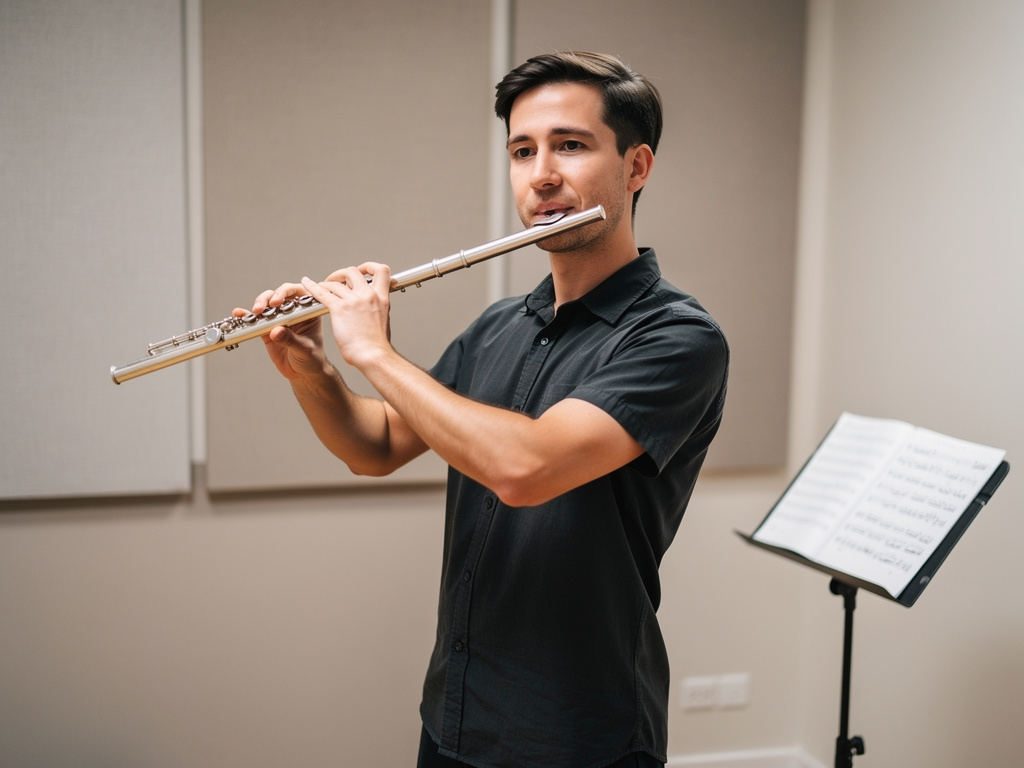
Once you have established the correct placement in your body awareness, the most valuable exercise you can do is deceptively simple and genuinely boring in the best possible way. Pick up your flute, establish your very best tone on a comfortable pitch — a sustained, resonant, centered note you would be proud to play in any context — and then introduce single tah strokes on that same note at a slow tempo. The only thing that should move is your tongue. Your jaw stays still. Your embouchure stays exactly as it was during the uninterrupted tone. Your air column flows continuously and supported beneath each stroke. What you are listening for is this: does the tone remain perfectly steady and consistent with each interruption, or does it wobble, waver, or change character when the tongue moves? The sustained tone exercise is unforgiving in the best way, because it will immediately reveal any place where your articulation is disrupting the very foundation of your sound. If the embouchure bounces with each tah, you will hear it. If the air stops flowing and restarts, you will hear that too. This exercise is the single best diagnostic and developmental tool for single tonguing, and even advanced players return to it daily because it keeps the fundamentals honest.
Double tonguing is the technique that opens up the repertoire that simply cannot be performed with single tonguing alone — the fast Baroque ornamentation, the rapid Classical passages, the athletic runs in orchestral scores that require note speeds no single-tongue stroke can sustain at the necessary tempo. The syllables are tah-kah, alternating between a stroke that uses the front of your tongue near the alveolar ridge and a stroke that uses the back of your tongue further back in the mouth, and the goal is for both strokes to be identical in volume, crispness, and character. This is where most students derail their double tonguing development immediately, because the natural inequality between the two strokes — most people's tah is stronger and cleaner than their kah — becomes a speed problem rather than a technique problem when they try to accelerate before the inequality is resolved. When you are building double tonguing, start at forty to fifty beats per minute and speak the syllables tah-kah-tah-kah alternating slowly, paying extreme attention to whether both strokes feel equally easy and sound equally clear. If they do not, slow down further. There is no stage of learning where practicing an uneven pattern at speed is more valuable than practicing an even pattern slowly. Speed is built on the foundation of evenness, and evenness must come first.
One of the most damaging assumptions a student can make about double tonguing is that it is a fix for slow or unclear single tonguing. It is not. Double tonguing is a supplement to excellent single tonguing, not a replacement for it. If your single tah strokes are heavy, effortful, or uneven, your double tonguing will amplify those problems rather than solving them, because the muscle memory your tongue learns during slow single tonguing directly shapes what happens when you add the second syllable. Get your single tonguing as relaxed, light, and automatic as you possibly can before you introduce double tonguing at any tempo. The same principle applies to triple tonguing, which uses tah-tah-kah or a similar three-syllable pattern and allows even faster repetition for specific passage types. Each layer of complexity requires the previous layer to be solid, and the foundation of all of them is a clean, effortless, single tah stroke that you could produce with your eyes closed and your mind completely elsewhere.
End every articulation practice session with a return to slow, relaxed, beautiful single tonguing on something simple and musical. This is not optional advice from a teacher who does not understand how much you want to get to the hard stuff. This is a specific technique for preventing the gradual accumulation of tension and heaviness that naturally develops in your articulation when you spend practice time working at the edges of your ability. Play a scale or a simple melody you know well, tongue it slowly and gently at sixty beats per minute, and let the quality of each individual attack remind your body what your default should feel like. Your practice session ends on that note, and your next practice session begins with that sensation already reinstalled.
The students who develop beautiful articulation are rarely the ones with the most talented tongues or the fastest tongues. They are the ones who understood, early, that articulation is a conversation between the tongue and the air, and that conversation requires the air to keep flowing even when the tongue is moving. They kept the breath going. They kept the embouchure still. They slowed down when things were uneven and trusted that speed would come after evenness was established. They practiced their single tonguing long after they could already do it, because they understood that excellence at the fundamentals is not a stage you pass through and leave behind. It is a standard you maintain for the entire life of your playing. Keep the air continuous, keep the tongue relaxed, and give that conversation the attention it deserves. Every note you play is waiting for a beginning worth hearing.
Comments
Post a Comment