Why Your Warm-Up Is the Most Important Fifteen Minutes of Your Practice

There is a version of the practice story that every flute teacher has heard so many times they could tell it in their sleep. A student arrives at a lesson having practiced all week, having genuinely tried, and the first thing the teacher notices is that the embouchure is tight, the tone is thin, and the fingers are stumbling over passages that were solid the week before. The student, bewildered, says they practiced for two hours on Tuesday and an hour on Wednesday. And the teacher thinks: you practiced. But did you warm up? Those are not the same thing, and understanding why they are different may be the single most important shift you can make in how you approach this instrument.
Think of warming up the way any serious athlete thinks about their pre-workout routine. A basketball player does not sprint onto the court without getting their legs loose first. A singer does not walk onto a stage and immediately belt their highest notes without some kind of vocal preparation. The body needs a signal — a gentle, incremental ramp-up that tells your muscles and your nervous system what you are about to ask of them and gives them a chance to prepare. Your flute mechanism is not exempt from this reality. Your embouchure muscles need gradual, gentle work before they can sustain the demands of a full practice session. Your diaphragm needs time to find its supported, engaged position before you ask it to maintain a steady flow of air through a long phrase. Your fingers need to reestablish their familiarity with the key layout and spring resistance before you ask them to execute fast, complex passage work. Skipping the warm-up does not make you more efficient. It makes you more likely to build tension into your technique, more likely to ingrain compensations for an unprepared mechanism, and more likely to spend the rest of your session practicing the wrong version of things.
The single most foundational element of any flute warm-up is long tones, because long tones reveal things about your playing that faster work conceals. When you are playing a scale or an etude at tempo, your attention is distributed across multiple demands simultaneously — finger coordination, embouchure adjustment, breath support, articulation, musical expression — and problems in any one of those areas can hide behind the complexity of the whole. Long tones strip that complexity away. One pitch, sustained, nothing to hide behind. If your embouchure is unstable, you will hear it wobble. If your breath support is inconsistent, the note will drift in volume or pitch in a way that you simply cannot miss. If your air is not flowing continuously, the resonance breaks and you will hear exactly where and why. Long tones are diagnostic before they are developmental, and the diagnostic information they give you is the most honest possible assessment of where your playing is starting from today, which is the only useful starting point for everything else you will do in this session.
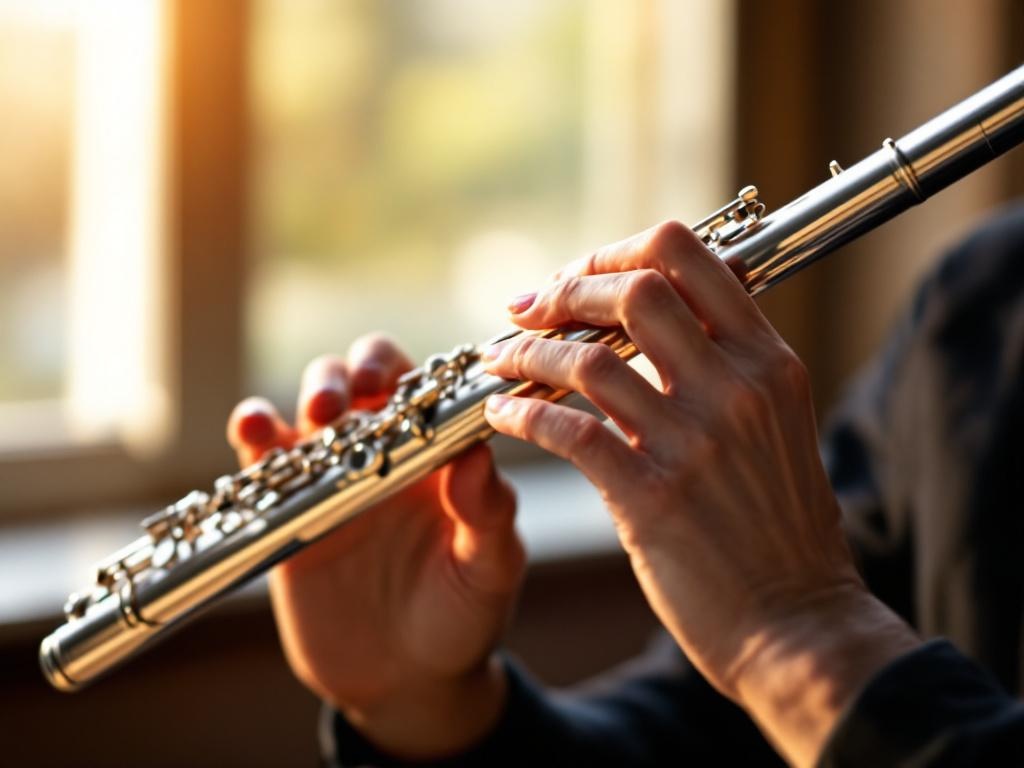
Here is a specific long-tone exercise I want you to build into your daily routine starting today. Choose one pitch in the middle register — middle D or B works well for most flutists — and sustain it for a full eight counts at a piano dynamic, which means soft but not whisper-thin, present but gentle. As you sustain the note, focus entirely on three things: evenness of sound from the very first moment of the attack to the very last moment before you release, centered tone without wobble or pitch wavering, and breath continuity where the air flows smoothly and continuously from start to finish without stopping or stuttering at any point. When you have completed that sustain, move to a different pitch in a different register — a low note and a high note — and repeat the exact same exercise on each. What you are establishing with this drill is a baseline for your embouchure and breath support across the full range of the instrument before you add the complexity of fingerwork and faster passage demands.
After long tones, move into a major scale or two played slowly and musically, and here is where I want you to do something that most students skip because it feels like administrative overhead rather than music-making: use a tuner. Play a one-octave C major scale at sixty beats per minute, holding each pitch long enough to verify that it is centered and stable before you move to the next. The scale wakes up your finger coordination across the full range of the instrument, familiarizing your hands with the key layout and the specific finger patterns for major scale architecture. The tuner gives you real-time feedback on your intonation that playing without a tuner cannot provide. If you have been sitting consistently sharp on a particular note, the tuner shows you that pattern. If your low register has been drifting flat during slow sustained passages, the tuner shows you that too.
Once your embouchure is warm and your fingers have reestablished contact with the key layout, add one more element before you touch your actual repertoire: a slow articulation starter. Choose a simple five-note ascending and descending pattern — root, second, third, fourth, fifth, and back down — and tongue it at sixty beats per minute with clear, relaxed tah strokes. The goal is not speed. The goal is evenness, crispness, and complete physical relaxation throughout your face and air system. Notice whether both ends of the pattern feel and sound identical in quality. Notice whether each individual attack begins cleanly without breathiness or harshness. If your articulation feels heavy or effortful here, it will feel heavier and more effortful in your repertoire. This is the place to find that out, when your only job is observation and the stakes are zero.

Keep your entire warm-up to fifteen or twenty minutes maximum. I know that sounds like a significant chunk of time when you are eager to get to the exciting new piece you have been saving all week, but consider the math honestly. Fifteen minutes of focused, purposeful warm-up makes every minute of repertoire practice that follows more productive, because you will be practicing with a prepared body, a responsive embouchure, an engaged ear, and fingers that know where they are going. If you are genuinely short on time on a particular day — and every student has those days — a short warm-up is always better than no warm-up. Five minutes of long tones, a tuner scale, and a slow articulation exercise is better than playing nothing before you head to your lesson.
The students who improve the fastest over months and years are not the ones with more natural talent or more hours to practice. They are the ones who have built the discipline of warming up as a non-negotiable part of their daily routine, who treat the warm-up as the serious first act of every practice session rather than an optional prelude that can be skipped when life gets busy. The long-tone baseline, the tuner scale, the slow articulation starter — these are not exercises for beginners only. They are the daily maintenance of a high-functioning flute mechanism, and skipping them does not make you more advanced. It makes you more prone to the kind of subtle, accumulated technical degradation that you will not notice until it has become a significant problem requiring far more time to fix than the warm-up ever would have taken. Show up every single day, even the short days, even the low-energy days. Warm up with attention and intention. Trust that the fundamentals applied consistently are more powerful than the techniques applied sporadically. Your embouchure, your breath, your fingers, and your ears are waiting for you to show up for them properly. Give them the warm-up they deserve, and watch how much better everything else sounds because of it.
Comments
Post a Comment